

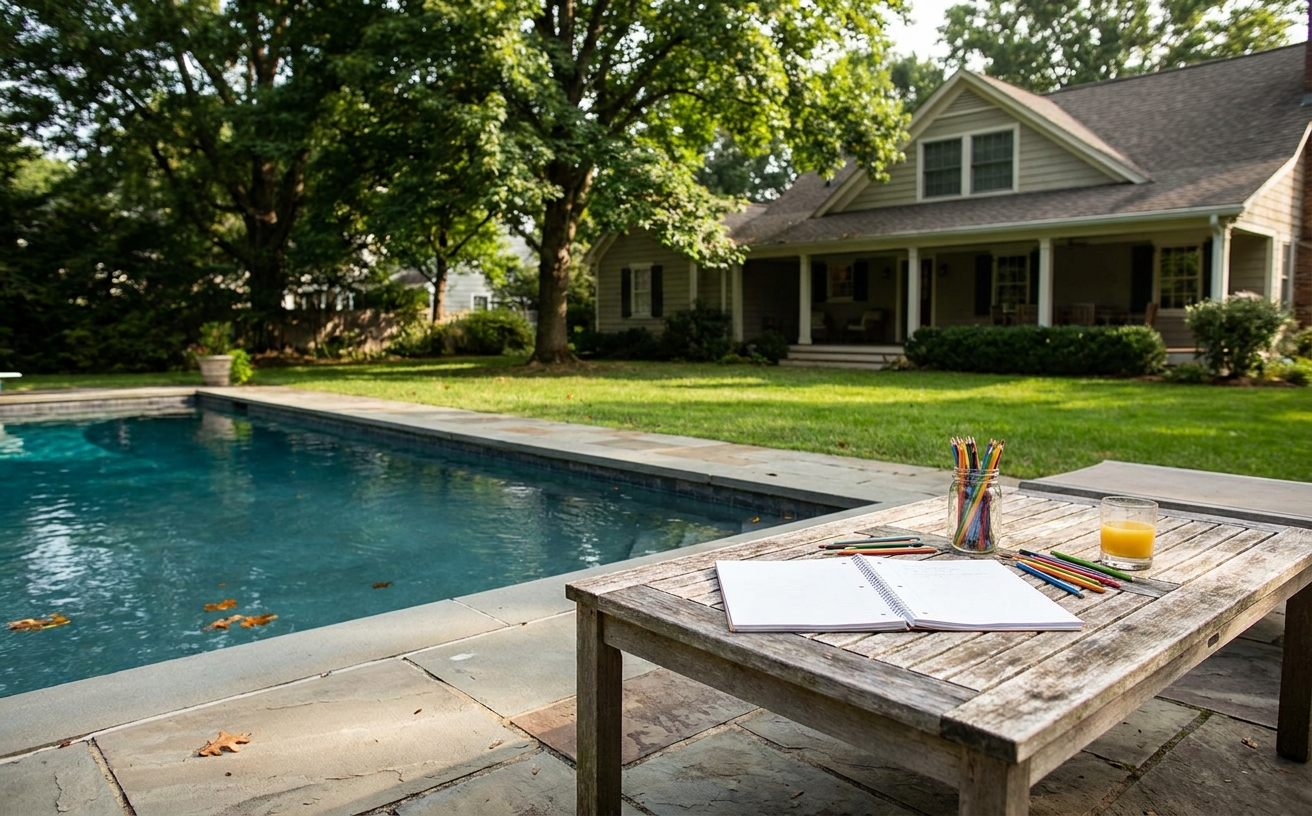
Summer learning does not have to look like worksheets at the kitchen table. Sometimes it looks like a notebook on the patio, a pencil beside a glass of lemonade, and a child staring at the pool surface long enough to notice what moves, floats, sinks, and changes.
A backyard pool can become a surprisingly useful observation space.
It is not only a place for splashing and weekend fun. It is also a small outdoor system. The water reflects light. Leaves collect in patterns. Wind changes the surface. Shadows move across the deck. Bugs appear after rain. Towels dry faster in one spot than another.
For kids, these small details can turn into questions.
Why do leaves gather near the steps?
Why does the water look different in the morning?
Why does a toy float but a rock sinks?
Why does the patio feel hotter than the grass?
That curiosity is worth encouraging.
Start With Looking, Not Explaining
Adults often rush to explain things. Kids sometimes learn more when they are first allowed to observe.
Give them a simple notebook and ask them to draw what they see around the pool. Not perfectly. Just honestly.
They might draw the waterline, a leaf, the ladder, the shade from a tree, a floating toy, or ripples after someone steps into the pool.
The goal is not art. The goal is attention.
A pool area is full of small changes that are easy to miss. When kids slow down enough to draw or describe them, they begin to see the backyard differently.
They stop treating it only as a play space and start seeing it as a place with patterns.
Make a Pool Weather Journal
A pool weather journal can be simple. Each day, kids write the date, weather, temperature if they know it, and one thing they notice about the pool.
The note might say:
- Windy today, leaves near the deep end.
- No wind, water looks smooth.
- After rain, patio is wet and worms are near the grass.
- Hot day, towels dried fast.
- Cloudy morning, water looks darker.
These little observations teach cause and effect.
Kids begin to connect weather with what happens in the yard. Wind moves leaves. Sun changes shadows. Rain changes the patio. Heat changes how people use the space.
That is science in plain language.
No textbook needed.
Try a Floating and Sinking Tray
One easy activity is a floating and sinking tray. Choose safe household items and test them one by one with adult supervision.
Use things like a leaf, plastic spoon, small rubber ball, cork, twig, toy boat, or coin. Ask kids to guess first, then observe what happens.
Keep it simple.
The important part is the prediction. Kids learn that science begins with a guess, then a test, then a result.
Afterward, ask why they think each object behaved that way. Do not worry if the answers are not perfect.
The point is to help them think.
A pool makes the experiment feel more exciting than a bowl of water at the kitchen sink.
Study Shadows Around the Pool
Shadows are one of the easiest backyard lessons.
Have kids trace where shade falls in the morning, afternoon, and early evening. They can mark it in a notebook or take photos from the same spot.
This helps them understand how the sun moves across the yard.
It also has practical value. They can see why one chair is comfortable in the morning but too hot after lunch. They can notice where a towel dries fastest or where a younger sibling should sit when taking a break from swimming.
Shadow tracking teaches observation, but it also teaches real-life planning.
That makes the lesson feel useful.
Keep Maintenance From Taking Over the Lesson
If the pool area looks like a task list, kids may not see it as a learning space. They may see adults constantly reacting to leaves, tools, hoses, or towels.
That does not mean the pool needs to look perfect. It means repeated upkeep should not become the center of every outdoor moment.
For families who want the pool to stay more ready for everyday use, an automatic pool cleaner robot can sit inside a broader household routine that keeps the water from becoming the first distraction whenever kids step outside to observe, draw, or learn.
The learning space works better when the basics feel under control.
A child cannot focus on ripples and reflections if everyone is rushing around fixing the area first.
Give Kids One Real Responsibility
Observation becomes more meaningful when kids also help care for the space.
Give them one small job connected to the pool area. It should be age-appropriate and clear.
They might:
- Put pool toys back in the bin.
- Place used towels in the hamper.
- Check whether the shade notebook was updated.
- Collect fallen leaves from the patio, not the water.
- Make sure outdoor pencils and notebooks come back inside.
This teaches that outdoor spaces need care.
It also helps kids understand that a pool is not just something adults magically maintain.
Shared spaces work because people share responsibility.
Use the Water as a Reflection Lesson
Water reflection can become a quiet activity. Ask kids to look at what the pool reflects.
Can they see the sky? Trees? the fence? clouds? the roofline? patio chairs?
Then ask what changes when the water moves.
A still pool may show a clear reflection. A moving pool breaks the image into pieces. A cloudy day changes the colors. Evening light changes everything again.
This is a beautiful way to teach observation without making it feel like school.
It also encourages calm.
Not every pool activity has to be loud.
Create a Backyard Question Board
Kids ask good questions, but those questions disappear quickly if nobody saves them.
Create a small question board or notebook page.
Write down questions like:
- Why does the water feel warmer at night?
- Why do bugs gather near the light?
- Why does wind push things to one side?
- Why do some towels dry faster?
- Why does the pool look blue?
You do not need to answer every question immediately.
Some can become research topics. Some can become experiments. Some can stay open for later.
The question itself is valuable.
A curious child is already learning.
Add Reading to the Pool Routine
A pool observation lab does not have to be all experiments. Add books.
Choose library books about weather, water, insects, birds, backyard plants, or simple science. Keep them inside, but bring one out during quiet pool time.
Read a few pages, then look around the yard for something connected to the book.
If the book mentions clouds, look at the sky. If it mentions insects, watch the patio. If it mentions floating, test a safe object. If it mentions birds, listen for calls.
This connects reading with real life.
The backyard becomes the example.
Teach Respect for Water
A learning pool is still a pool. Safety has to stay clear.
Set rules before any activity:
- No observation near water without an adult if children are young.
- No leaning too far over the edge.
- No running with notebooks or pencils near the pool.
- No throwing unsafe objects into the water.
- No experiments without permission.
These rules do not ruin the activity.
They make it possible.
Kids can learn curiosity and caution at the same time.
That is an important summer lesson.
Let the Project Stay Casual
Do not turn the backyard observation lab into a strict curriculum. If kids feel tested, the fun disappears.
Let some days be simple.
One drawing. One question. One floating test. One weather note. One quiet look at the water before swimming.
That is enough.
Summer learning works well when it feels woven into life, not forced on top of it.
The pool gives children a reason to go outside and notice things.
That may be the most important part.
A Pool Can Teach More Than Swimming
A backyard pool can teach responsibility, patience, observation, weather awareness, safety, and curiosity. It can help kids see that the world changes in small ways every day.
They learn that wind leaves clues. Water reflects light. Shade moves. objects behave differently. Shared spaces need care.
These lessons are ordinary, but they last.
Not every summer memory has to come from a big trip or expensive camp. Some come from the backyard, a notebook, and a child noticing something for the first time.
A pool can be a classroom without becoming school.
It can be a place where learning feels like looking, wondering, testing, and stepping back into the water when the lesson is done.
